Stores Built To Sell
E-commerce development for stores that get found and stay easy to run
Build and Convert
A store adds moving parts, and the parts decide whether anyone buys
E-commerce development from CICOR Marketing is a complete online store build on WooCommerce or Shopify for businesses that want to sell when the doors are closed. We set up the platform, design the store in your brand, structure the catalog, configure payment, shipping, tax, and inventory, and add the product schema that puts prices and availability in Google Shopping and AI shopping results. The store connects to the accounting, shipping, and email tools you already run. Every store is quoted from a fixed scope after a short discovery call.
Take a marine parts maker with 400 products and a phone that rings all day with orders. The owner wants those orders online, so the staff can build parts instead of taking calls. The store that works is not the prettiest one. Its catalog is organized the way a boat owner searches. Its checkout does not fail on a phone. Shipping and tax calculate correctly, and each product page tells Google what it sells and what it costs. The maker is invented, but that is the list we work through on every store.
An online store adds products, variations, shipping, tax, payment, inventory, and the product content that decides whether anyone finds and buys. Miss one and the store leaks sales quietly. Get them right and the store does the work your phone used to.

Who It Fits
Who this is the right fit for
This service fits a business with products to sell online for the first time, a store on a platform that has become hard to manage, or a catalog that has outgrown a plugin. It fits a retailer with 40 products and a manufacturer with 400. It is one of four services in the Build and Convert group.
It is not the right fit if you do not sell products online; Website Design and Development is the right build for a service business. It is also not a fulfillment or customer service operation. We build the store and train your team to run it, and the day-to-day selling stays with you.
What Is Included
What is included
TECHNICAL
Platform setup and design in your brand
We set up WooCommerce or Shopify, choose and configure the theme, and design the store in your brand.
BUILD
Catalog structure and product pages
We build the category structure the way your customers shop, import the product data you supply in our template, and create the product page templates.
DIAGNOSIS
Payment, shipping, tax, and inventory
We configure supported payment gateways, shipping rules and rates, tax calculation, and inventory tracking, then test every combination before launch.
FOUNDATION
Product schema, categories, and technical SEO
Every product page carries product schema: name, price, availability, and reviews where you have them.
EXECUTION
Cart, checkout, and abandoned-cart email
Checkout is tested on phones first, because a checkout that fails on a phone loses the sale without a word.
ENABLEMENT
Training and handoff
Your team learns how to add products, process orders, change prices, and run a sale. You get handoff documentation and you own the store outright once it is paid for.
How We Work
How it works
A store follows the same six phases as a website build, with catalog import and checkout testing added to development. Stores with more than 100 products or custom integrations get a discovery phase first, so the estimate is built on facts.
1. Discovery. Catalog size, platform, integrations, shipping and tax rules, and who will run the store.
2. Design. Store and product page mockups in your brand, with two rounds of revisions.
3. Catalog build. Category structure, product templates, and the import of your product data.
4. Development. Payment, shipping, tax, inventory, and the connections to your accounting, shipping, and email tools.
5. Schema and testing. Product schema on every page, then test orders through every payment and shipping combination.
6. Launch and handoff. Staging review, launch, training, and documentation.
Why It Matters
Why CICOR Marketing for your store
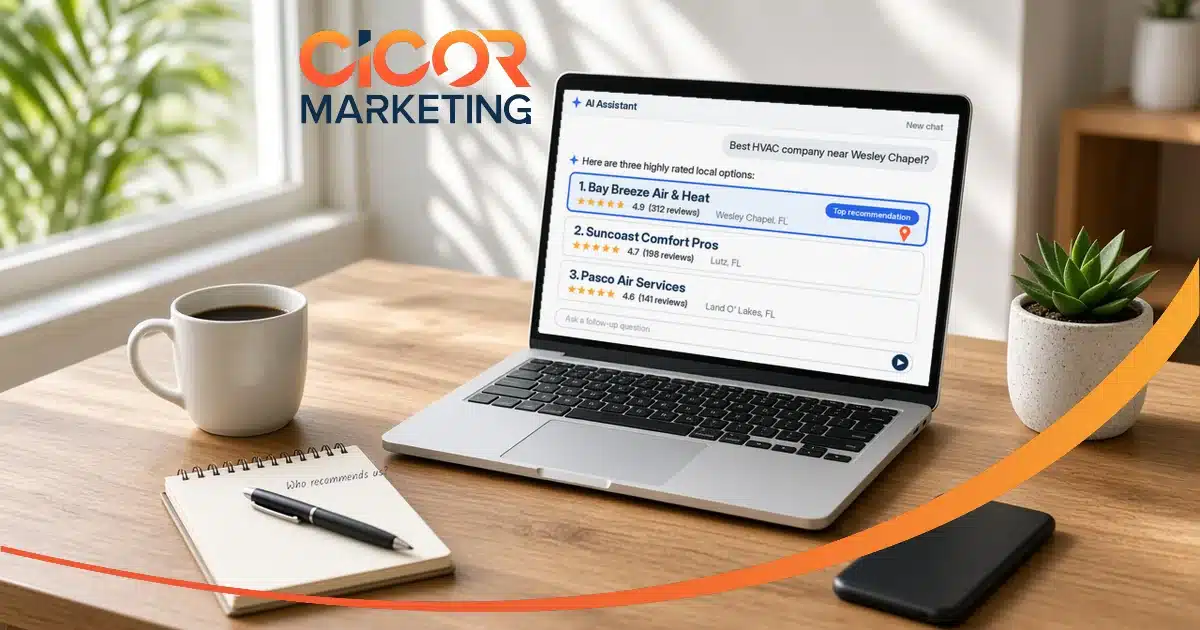
Most store builders stop at the checkout. We build the structure that gets products found, because a store nobody finds is a warehouse with a website. Product schema, category pages that match how people search, and clean internal links are in every build. They are the same signals AI platforms read when a shopper asks for a recommendation.
CICOR Marketing is a full service marketing agency in Tampa, Florida, with a second office in Naperville, Illinois, and clients across more than 50 industries, including retail and manufacturing. When the store is live, the same team can run the ads and the email that fill it.
Start The Conversation
Ask About E-commerce Development
Tell us what you are trying to achieve. CICOR Marketing replies within one business day with next steps.
- A reply from CICOR Marketing within one business day
- A free consultation, limited to 30 minutes
- A plan before any spend
E-commerce Development FAQs
When evaluating e-commerce platforms, the most important features are those that directly affect the ability to sell, scale, and manage operations efficiently. Core requirements include product catalog management with support for variants, a secure checkout supporting multiple payment methods, and mobile-optimized design that performs well across devices. These are the fundamentals, poor performance on any of them will directly and measurably hurt sales.
Inventory management capabilities are critical for businesses with physical products. Real-time stock tracking, low-inventory alerts, and integration with suppliers or fulfillment partners prevent the customer experience problems caused by overselling or unexpected delays. For businesses selling across multiple channels, inventory that syncs across the online store, marketplaces, and retail locations is essential for operational accuracy.
SEO and marketing integrations determine how effectively the platform supports business growth beyond its own storefront. Platforms should support clean URLs, meta tags, structured data, and fast load times; all factors that affect search visibility. Integration with email marketing tools, ad platforms, and analytics systems ensures the store is connected to the full marketing ecosystem rather than operating as an isolated sales channel with limited ability to attract new customers.
Small businesses are among the primary beneficiaries of modern e-commerce platforms. The technology that was once available only to large retailers with significant IT budgets is now accessible through platforms like Shopify, WooCommerce, and BigCommerce at a fraction of the historical cost. Small businesses can build functional, professional online stores that compete effectively with larger companies on the quality of the buying experience.
The scalability of e-commerce is particularly valuable for small businesses. A single employee or small team can manage an online store serving hundreds or thousands of customers simultaneously, a scale that would be impossible through a purely physical or manual operation. Automation handles order processing, inventory tracking, shipping notifications, and follow-up communications, reducing the hands-on time required to operate at volume.
E-commerce also opens geographic markets that are inaccessible through physical retail alone. A small business that previously served only its local area can sell nationally or internationally through an online store. For businesses with products that have appeal beyond their immediate market, e-commerce is one of the most transformative growth opportunities available, regardless of company size.
E-commerce solutions are the platforms, tools, and systems that enable businesses to sell products and services online. At their core, they include the storefront where customers browse and purchase, the payment processing system that handles transactions securely, and the backend tools that manage inventory, orders, and fulfillment. Modern e-commerce solutions range from all-in-one platforms like Shopify to custom-built systems for businesses with complex or specialized requirements.
They are important because online selling is no longer optional for most product-based businesses and increasingly valuable for service businesses as well. Consumer behavior has shifted toward researching and purchasing online across virtually every category. Businesses without an e-commerce presence limit themselves to local or referral-driven customers and cede ground to competitors who are accessible at any time from any location.
Beyond revenue generation, e-commerce solutions provide operational infrastructure that improves efficiency and visibility across the business. Order management, inventory tracking, customer records, and sales reporting are centralized in the platform, reducing administrative burden and giving leadership better data to make decisions. For businesses looking to grow beyond the constraints of physical operations, an e-commerce solution is the enabling infrastructure that makes that scale achievable.
A successful e-commerce store requires several non-negotiable capabilities. Secure, fast-loading product pages with high-quality images, detailed descriptions, and clear pricing are the foundation, this is what customers evaluate before committing to a purchase, and poor product presentation directly reduces conversion rates. Mobile optimization is equally critical, as the majority of online shopping now occurs on smartphones, and a checkout that is difficult to complete on mobile loses a significant portion of potential sales.
A streamlined checkout with multiple payment options; credit cards, digital wallets like Apple Pay and PayPal, and buy-now-pay-later options, reduces the abandonment that occurs when customers encounter friction or cannot find their preferred payment method. Guest checkout is important for first-time buyers who are not ready to create an account. Clear shipping costs, delivery timelines, and return policies shown before checkout reduce the last-minute hesitation that causes cart abandonment at the final step.
Beyond the core purchase flow, features that support growth include integration with marketing platforms, search functionality that helps customers find products quickly, product reviews that build social proof, and SEO capabilities that generate organic traffic. Inventory management, order tracking, and customer account features support retention and operational efficiency. The combination of a frictionless purchase experience with the marketing and operational infrastructure to drive traffic and build loyalty is what separates e-commerce stores that scale from those that plateau.
E-commerce solutions improve customer experience by making the entire shopping and purchase process faster, more convenient, and more transparent. Customers can browse at their own pace, access detailed product information, compare options, read reviews, and complete a purchase in minutes from any device. This level of accessibility and convenience is the baseline expectation for online shoppers, and businesses that deliver it reliably earn repeat customers.
Post-purchase communication is a high-impact area where e-commerce platforms differentiate the experience. Automated order confirmations, shipping notifications, and delivery updates give customers visibility into their order status without requiring them to contact the business. Easy returns and clearly communicated refund policies reduce friction when something goes wrong, building trust that converts first-time buyers into repeat customers rather than one-time transactions.
Personalization features within e-commerce platforms further improve the experience for returning customers. Saved addresses, payment methods, and order histories reduce the effort required for subsequent purchases. Product recommendations based on purchase history surface items relevant to what the customer has already bought. These features make returning to the store more convenient than searching elsewhere, which is the foundation of customer retention in e-commerce.
E-commerce solutions help businesses grow by creating a digital storefront that operates continuously without the geographic or time constraints of a physical location. Products and services can be sold to anyone, anywhere, at any time; eliminating the limitations of walk-in traffic and fixed business hours. This expanded reach allows businesses to scale revenue without proportional increases in overhead.
The growth impact extends beyond sales volume. Modern e-commerce platforms generate detailed data on customer behavior, purchase patterns, and product performance that supports better decisions about inventory, pricing, and marketing. Businesses that use this data to understand what sells, to whom, and under what conditions consistently make more effective decisions than those relying on intuition or limited visibility into actual buying behavior.
Integration with marketing channels amplifies growth further. When an online store is connected to email marketing, paid advertising, and organic search, the combination of traffic sources creates a sustainable growth engine. An email campaign driving past customers back to the store, Google Shopping ads reaching new buyers at the moment of intent, and SEO-optimized product pages building long-term search visibility all compound over time to produce growth that a physical-only or manually operated operation cannot match.

Ready When You Are
Start with the catalog, not the theme
The first question we ask is not what the store should look like. It is what you sell, how many ways it varies, and how your customers search for it. Answer those on the estimate form and you will have a platform recommendation, a scope, and a fixed fee within three business days.