Quantcast
Answer Engine Optimization (AEO)2026-05-22T16:07:56-04:00

Be the Brand with the Answer

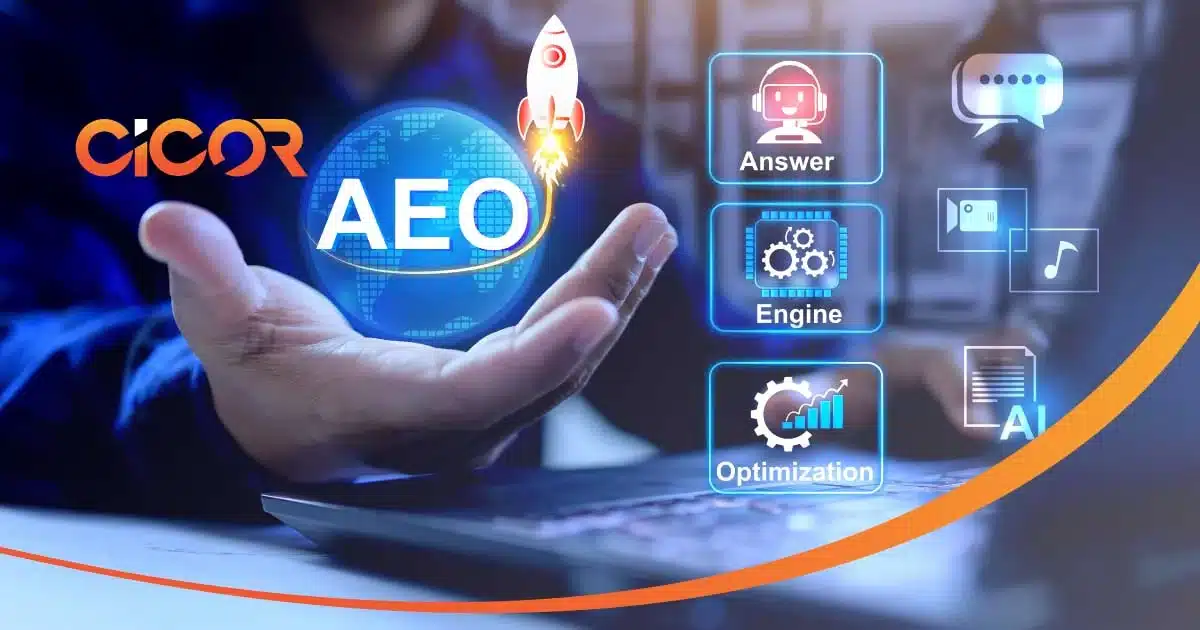
Answer Engine Optimization (AEO)
AEO Definition

Become the Brand AI Search Platforms Trust First

Position Your Brand as the Expert

Search behavior is changing quickly. Customers now expect direct answers from Google AI Overviews, ChatGPT, Perplexity, Siri, and voice assistants instead of scrolling through pages of search results. Businesses that become trusted sources in these systems gain visibility before competitors are even considered.

CICOR Marketing helps companies structure content, strengthen authority signals, and improve AI search visibility so their expertise appears where modern customers are already looking.

  • How can my business become the go-to expert that customers find first?

  • What does it take to win featured snippets and voice search results?

  • Why are my competitors appearing in answer positions while I’m not?

Consider this: when someone searches “How do I choose the right accountant?” the business that provides the featured answer wins instant credibility and customer trust. While your competitors fight for traditional rankings, AEO positions your business as the authoritative expert customers discover first and choose most often.

When customers ask questions in your industry, does AEO ensure they hear your voice first?

What Exactly Is Answer Engine Optimization (AEO)?

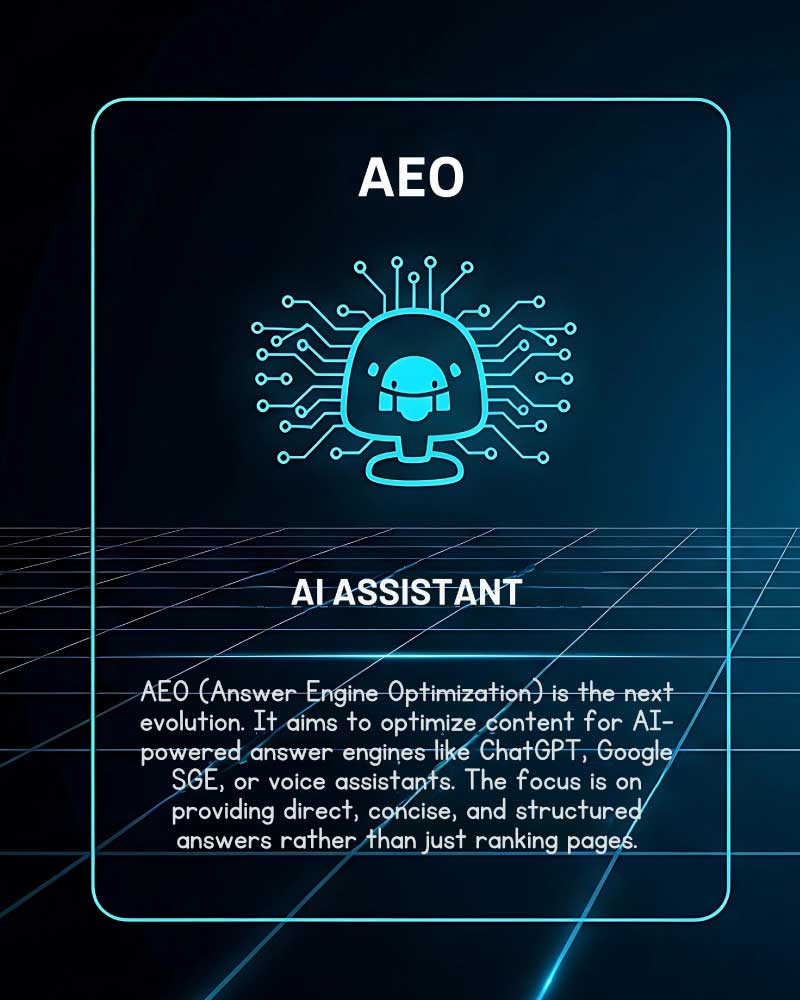
Answer Engine Optimization (AEO) is the strategic process of optimizing your content to appear in featured snippets, voice search results, and answer boxes across search platforms. At CICOR Marketing, we’ve perfected this approach to position your business as the immediate, authoritative answer to customer questions on Google, Siri, Alexa, and other platforms. While your competitors focus on traditional SEO tactics, we ensure your expertise becomes the trusted voice customers hear first.

CICOR Marketing recognizes that today’s customers want instant answers rather than exploring multiple websites. When someone asks “best accounting software for restaurants” or “how do I know if I need a business lawyer,” our AEO strategies ensure your brand provides that crucial first response. We transform search engines into powerful referral sources that pre-qualify prospects by showcasing your knowledge, building trust and authority before they ever visit your site.


What is AEO?
AEO Solutions

Why Your Business Needs AEO – Answer Engine Optimization Now

Instant Authority, Lasting Impact 

Modern search has evolved beyond the click-and-hope approach of traditional SEO. Answer Engine Optimization delivers something far more powerful: instant credibility that positions your business as the go-to expert before prospects even consider your competitors. When your insights consistently appear as the featured answer to industry questions, you’re not just gaining visibility—you’re building a reputation as the authoritative voice customers can rely on.

How CICOR Marketing Transforms Your Online Presence

With over 25 years of experience in digital marketing and web design, CICOR Marketing has successfully delivered results across more than 50 industries. Our expertise and adaptability ensure your business thrives in the ever-changing digital landscape.

Research That Reveals Opportunities

Our proven AEO strategy starts with understanding exactly how your customers search for information. We identify the specific questions your potential customers ask, uncovering opportunities your competitors miss because they’re still focused on traditional keyword strategies.

Content That Converts 

We craft content that directly answers customer questions while showcasing your expertise. Our structured approach uses clear headings, bullet points, and logical flow that both search engines and humans find easy to understand. 

Answer Engine Optimization (AEO) FAQs

How is AEO different from traditional SEO?2026-06-15T16:03:13-04:00

AEO focuses on earning direct answers, while traditional SEO focuses on earning ranked positions in search results. Traditional SEO helps a page appear in the list of results when someone searches a keyword. AEO helps content become the answer that gets surfaced above those results; in a featured snippet, a Google AI Overview, a voice assistant response, or a generative AI tool’s reply.

Both disciplines share a foundation. Strong technical SEO, well-researched content, and credible backlinks support both. But AEO requires additional attention to how content is structured at the sentence and paragraph level. Clear questions followed by concise answers, proper use of heading hierarchy, FAQ schema markup, and content that addresses a single topic thoroughly are all characteristics that AEO prioritizes.

As search behavior shifts toward conversational queries and AI-assisted research, AEO is becoming a more significant part of overall visibility strategy. A page that ranks well in traditional search may still be passed over by AI systems if it does not surface a clear, extractable answer near the top of the page.

What types of businesses benefit most from AEO?2026-06-15T16:31:22-04:00

Businesses that see the strongest results from AEO tend to be those whose customers research before making a decision. Professional services: law firms, accountants, financial advisors, healthcare providers; benefit significantly because prospective clients often search for answers to specific questions before reaching out. Home services, contractors, and local businesses benefit because voice search and AI tools are increasingly used for “near me” and recommendation queries.

AEO is also particularly valuable for businesses with longer sales cycles, where the buyer needs to understand options, compare providers, or build trust before taking action. Being the business whose content answers those research questions consistently builds familiarity and credibility before the first conversation happens.

Niche B2B companies, SaaS products, and any business competing in a space where education is part of the sales process also benefit. When a prospect asks an AI tool to explain a concept or recommend a solution, the businesses whose content is clear, well-structured, and authoritative on that topic are the ones most likely to be cited or recommended.

Can I tell AI tools which pages to prioritize?2026-06-16T14:00:35-04:00

You cannot directly instruct AI language models to prioritize specific pages from your site, but you can make it significantly easier for them to find, understand, and use your most important content. One practical method is adding an llms.txt file to your domain root; a plain-text document that outlines your site’s structure, key pages, and their purpose, formatted specifically for AI agents and crawlers rather than human readers.

Beyond llms.txt, on-page signals matter. Content that opens with a clear, direct answer to the question the page addresses is more likely to be extracted by AI systems than content that buries the key point. Proper use of heading hierarchy (H1, H2, H3), FAQ schema markup, concise meta descriptions, and internal linking from high-authority pages all signal which content is most important and what it covers.

Technical accessibility is also a factor. Pages that are crawlable, indexed, and load quickly on all devices are more likely to be included in AI training and retrieval pools. Combining these structural signals with factually accurate, well-sourced content gives your highest-priority pages the best possible chance of being recognized and used.

What is Answer Engine Optimization (AEO)?2026-06-15T16:11:15-04:00

Answer Engine Optimization, or AEO, is the process of structuring content so search engines and AI tools can use it as a clear answer to a user question. AEO supports visibility in featured snippets, Google AI Overviews, voice search responses, and citations in tools like ChatGPT, Perplexity, and Microsoft Copilot, wherever users go to get a direct answer rather than a list of links to click through.

Traditional SEO focuses on ranking a page for a keyword. AEO focuses on making the content on that page extractable as a direct answer. This means organizing information with clear questions and concise responses, using structured data like FAQ schema, writing introductory sentences that contain the core answer, and covering a topic with enough depth that AI systems treat the content as a credible source.

AEO matters more as search behavior shifts toward conversational queries and AI-assisted research. When someone asks a question by voice, types a full sentence into a search bar, or prompts an AI chatbot, they expect an answer; not a list of ten blue links. Content built with AEO in mind is positioned to meet that expectation across every channel where people are looking for information.

How Does Google’s Agentic Booking Feature Work, and Does It Affect My Business?2026-08-28T15:05:07-04:00

Agentic Booking is one of the new capabilities Google introduced alongside its AI search agents. For local service businesses, home repair, beauty and personal care, pet care, and similar categories, Google’s AI can check a business’s pricing and availability, and in some cases place the call or complete the booking itself on the customer’s behalf. Instead of a person searching, calling a few businesses, and comparing answers manually, the AI agent can do much of that legwork directly, then hand the customer a completed or near completed booking with little effort on their part. Google has framed this as a convenience for the customer, and for many people it will be exactly that, but it introduces a genuinely new kind of visitor for a business to think about, one that is software acting on a person’s behalf rather than a person casually browsing a website and forming their own impression. That distinction matters because software does not read between the lines the way a person might, it either finds a clear answer to work with or it does not.

Whether this affects your business depends largely on how easy it currently is for an outside system, human or AI, to find your hours, services, pricing, and a way to book you. If that information lives only in a phone tree, a PDF, or an image on your website, an AI agent has very little reliable text to work with and may simply move on to a competitor whose information is easier to parse. If it is written clearly in plain text on your website and kept consistent with your Google Business Profile and other directories, an AI agent has a real chance of finding it, trusting it, and using it to complete a booking on the customer’s behalf. Home service businesses, healthcare and wellness practices, salons and spas, and other appointment based businesses are the categories most likely to see this play out first, simply because booking an appointment is already a common, well defined, repeatable action for those industries.

The businesses that benefit most from Agentic Booking will be the ones that treated their online information as a priority before this update ever launched, rather than scrambling to fix it after falling behind competitors who got there first. That means confirming that your services, pricing, and availability are described in plain language somewhere on your site, not only in a downloadable file or a graphic, and that your business details match exactly across your website, Google Business Profile, and any directory that lists you, down to how your street address or suite number is written. It also means thinking through what happens after an AI agent successfully books an appointment, whether your team gets a clear notification, and whether the time and service booked actually match what your calendar can support that day. This is exactly the kind of groundwork CICOR Marketing helps clients put in place through Answer Engine Optimization, so a business is genuinely ready to be found and booked by an AI agent, rather than hoping a human eventually reads past an outdated web page and calls anyway.

How long before these strategies produce measurable results?2026-06-01T15:36:56-04:00

Lead generation improvements through better content and landing pages typically show results within 60 to 90 days for organic traffic and faster for paid. Branding alignment has an immediate effect on conversion rates once changes are implemented, though building brand recognition in a market takes longer, often 12 to 18 months of consistent execution. GEO results vary based on how much credible content and authority you have already built.

Businesses with an existing content library that they reformat and optimize for AI readability tend to see movement in 90 to 120 days. Starting from scratch takes longer. The honest answer is that these are compounding strategies, which means the longer you stay consistent, the better they perform. 

Do AI systems always provide citations?2026-06-15T15:38:39-04:00

No. AI systems do not always provide citations, and the behavior varies significantly by platform and query type. Tools like Perplexity and Microsoft Copilot are designed to cite sources more consistently. ChatGPT and Google Gemini often synthesize answers from trained knowledge without linking to specific pages, particularly for general or evergreen topics.

Queries more likely to trigger citations include product recommendations, local business searches, recent events, how-to questions with clear procedural steps, and questions that require specific statistics or named sources. General knowledge questions may be answered entirely from a model’s training data with no live source referenced.

Optimizing content for AEO increases the probability that your pages are identified and used as source material, even when a visible citation link does not appear. Content that is factually precise, clearly structured, and consistently available for crawling is more likely to be drawn on by AI systems, whether or not the system surfaces a link to the reader.

What Does It Take for an AI Search Agent to Actually Find and Recommend My Business?2026-08-28T15:17:51-04:00

An AI search agent is only ever as good as the information it can find, read, and trust about a given business. Three things determine whether it finds yours at all, and none of them require rebuilding a website from scratch to fix. The first is accurate, structured information. Your services, hours, location, and pricing need to exist somewhere as plain, readable text, not buried inside a PDF, a scanned document, or a photo, since those formats are much harder for an AI system to reliably read, parse, and reuse with confidence. The second is consistency across every place your business appears online. Your business name, address, and phone number should match exactly across your website, your Google Business Profile, and every directory that lists you, because small mismatches, a suite number here, an abbreviation there, can create enough doubt that an AI system quietly skips over a business rather than risk recommending outdated or conflicting information to a real customer.

The third factor is content that actually answers questions, rather than content written only to describe a company in vague, general terms. AI systems favor pages that explain a topic clearly and completely enough to stand on their own, without requiring a reader to already understand the subject, the same standard CICOR Marketing applies when building a client’s website and educational content from the ground up. A page that answers a specific question a customer is likely to ask, in plain language, with enough detail to be genuinely useful on its own, is far more likely to be pulled directly into an AI generated answer than a page that only lists services without ever explaining what they actually involve. This is not a dramatically different bar than good, helpful writing has always required of a business. It is simply being enforced more directly and more consistently now, because an AI system is doing some of the reading and evaluating that a person used to do for themselves.

None of these three factors work particularly well in isolation from one another. A business can have beautifully written content and still be overlooked if its hours are wrong on even one directory, and a business can be perfectly consistent everywhere and still be passed over if its content never actually answers a real question a customer is asking. A business can also do all three reasonably well on its main website and still be missed if a busy third party directory that ranks well is the version an AI system happens to trust most, which is why keeping outside listings current matters as much as the website itself. This is the practical core of two disciplines CICOR Marketing specializes in, Answer Engine Optimization, which focuses on getting content chosen as the direct answer to a specific question, and Generative Engine Optimization, which focuses on how AI systems understand and recommend a business more broadly across many different tools. Traditional SEO has not gone away in any of this. It remains the foundation everything else is built on. It is simply no longer the whole picture on its own.

CICOR Marketing AEO Professional
Go to Top