Google’s November 2026 core update has been moving rankings, and AI answers on local searches are changing too. Site owners are talking about the shift, and AI Overviews often name different businesses than the Map Pack. Meanwhile, the tools most people use to measure all of this have struggled to keep up.
This is Part 1 of a two-part look at the update. It covers what Google has confirmed, what people have reported and what to note now. Part 2 covers the final results and anything new that Google releases.
What Google Has Confirmed About the November 2026 Core Update
Google started the November 2026 core update on November 10, at about 1 PM ET. It applies worldwide in all languages, and Google said the rollout may take up to two weeks. Google’s status page still showed the rollout in progress on November 19.
This is Google’s third core update of 2026, after the March and May updates. Google described it only as a regular update to “better surface relevant, satisfying content.” It has not shared any details about what actually changed.
How Long the Rollout Could Run
This year’s March and May core updates each finished in about 12 days. Recent November updates ran longer, with about 24 days in 2024 and about 26 days in 2023. If it used the full two weeks, it would end around November 24. A longer rollout could run into Black Friday on November 27 and Cyber Monday on November 30.
Google’s Standing Advice
Google’s published advice for core updates is short and has not changed. It says there are no specific actions you can take to recover. It also suggests waiting at least a full week after a rollout ends before comparing results.
What People Have Reported
When the Swings Showed Up
On November 16, Search Engine Roundtable reported that the largest ranking swings came around November 13 and 14. Chatter picked up on Saturday, November 14, and tracking tools showed more movement that day. An analyst quoted by Search Engine Roundtable believes the update truly landed on Friday, November 13.
What Site Owners and SEOs Are Saying
In the same report, Search Engine Roundtable described the chatter as more muted than for most core updates. Even so, site owners reported ranking changes, traffic gains and drops, and shifts in conversions. One site owner reported unusual jumps in Search Console clicks and impressions. Another said the results changed with every refresh of the page.
The analyst quoted by Search Engine Roundtable saw clear surges and drops starting November 13. The same analyst pointed to two sites dropping heavily that had scaled up with AI-generated content. These are early reports from individual sites, not patterns Google has confirmed. Early tracking data, including a UK snapshot from SISTRIX, showed sharp swings for individual sites but no clear winners or losers by industry yet.
Why the Numbers Are Hard to Read
Measuring this update has been harder than usual, so read early numbers with care. Search Engine Roundtable reported that some rank tracking tools were partly blocked by Google. Semrush said trackers were also filtering out bad results that Google returned. Search Console’s performance reporting was also slow or off for many sites.
Google also confirmed a logging error in Search Console’s generative AI report. It lowered reported impressions from November 9 to November 11, and Google says it affected data logging only. Add holiday shopping on top, and one week of numbers can tell you very little.
What to Watch and Note Now
- Check the Google Search Status Dashboard for the official end date of the rollout.
- Write down the date any big swing started on your own site.
- Save a Search Console export for November 2 to 8, the week before the rollout.
- Mark November 9 to 11 as unreliable in the generative AI report.
- Treat Search Console as your main source, and double check odd swings in rank trackers.
- Log holiday sales or promotions, so demand changes are not mistaken for ranking changes.
- Hold off on big site changes until Google marks the rollout complete.
- Ask AI tools the questions your customers ask, and note whether your business gets named.
- Group your keywords and AI prompts by topic, and track each topic as a whole.
These notes are for later, not for drawing conclusions today. They set you up for a fair comparison once the rollout ends and the data settles.
Separate but Related: AI Overviews Are Moving Into Local Search
A Semrush study published November 17 is separate from the core update, but closely related. It covered 480 high-intent local searches, run by hand across 12 US markets from September to November 2026.
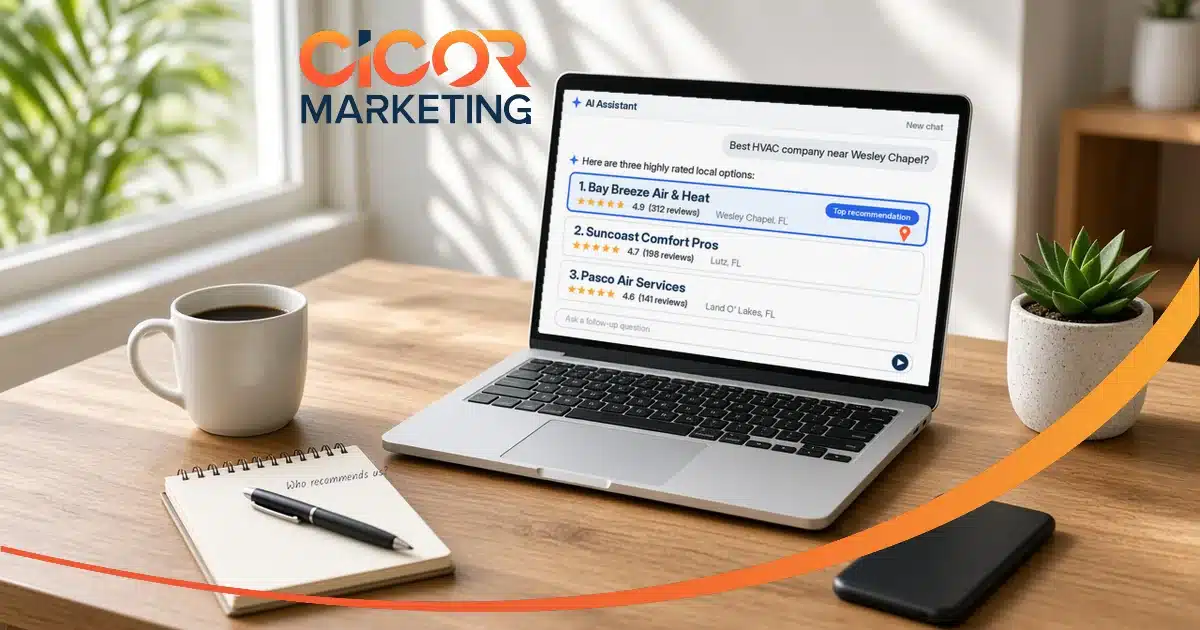
AI Overviews appeared on 38% of searches in the study’s first round. In the last round, they appeared on 99% of searches, or 79 of 80. In that round, the AI Overview replaced the Map Pack and showed businesses as cards.
What the Study Found About AI Answers and the Map Pack
When both shared a page, about one in five AI Overviews named none of the pack’s businesses. Also, 36% of the businesses that AI Overviews recommended had no page-one website ranking. Conversational searches, like “need an emergency plumber” plus a city, triggered AI Overviews more often than short keywords.
Semrush notes that the final round covered four markets on a single day. It could be a test or a partial rollout, so treat it as an early signal.
A Tested Market Close to Home
Naperville, Illinois, was one of the 12 markets in the study. CICOR has served businesses from Tampa and Naperville since 2013, so this research hits close to home. AI answers are already shaping local searches in suburbs, not just big cities.
Why AI Visibility Matters More Than the Map Pack Alone
For years, the Map Pack was the main goal for local businesses. This study suggests a Map Pack spot does not mean AI will name you. That makes AI visibility a core part of being found locally.
That is why AI search optimization, including AEO and GEO, is our top priority at CICOR. SEO is still the foundation, and AEO does not work without it. We build and run a combination of layers for clients to be found, chosen and cited.
What Local Businesses Can Do Now
- Keep your Google Business Profile accurate, because the study found AI Overview cards showed the same details.
- Build a helpful page for each service area you truly serve.
- Strengthen your listings on trusted third-party sites, like directories and review sites in your industry.
- Publish content that answers real customer questions, in the words customers actually use.
Why Topics Matter More Than Single Keywords
AI visibility and Google rankings are more connected than they look. A shift in Google rankings can also change how visible you are in AI answers. Semrush’s enterprise research found 90% of customer journeys with an AI touchpoint also included organic search. AI search also runs many related searches in the background, a process called query fan-out.
That is why it makes sense to measure visibility by topic, not single keywords or prompts. In Semrush research, only 15.2% of 1,094 topics in ChatGPT had a clear owner. A follow-up Semrush study linked depth within one category more closely to ChatGPT brand mentions than scattered visibility.
So build depth on your core topics before you expand into new ones. Reviews, community discussions and industry publications also shape how AI describes your brand. It is one more reason AEO needs a strong SEO foundation underneath it.
Coming in Part 2
Part 2 picks up once Google marks the rollout complete and reliable data is in. It reports the end date, the actual results and anything new Google releases about the update. It also walks through a fair before and after comparison, using the notes above.
Frequently Asked Questions
Want to Know Where You Stand?
If your numbers look confusing right now, our team can help you sort real changes from noise. Contact CICOR Marketing to talk through your SEO and AI visibility. To see whether AI tools name your business today, start with our AI Visibility Audit. Part 2 reviews the actual results once Google marks the rollout complete.
Table Of Contents
- What Google Has Confirmed About the November 2026 Core Update
- What People Have Reported
- Why the Numbers Are Hard to Read
- What to Watch and Note Now
- Separate but Related: AI Overviews Are Moving Into Local Search
- Why AI Visibility Matters More Than the Map Pack Alone
- Why Topics Matter More Than Single Keywords
- Coming in Part 2
- Frequently Asked Questions
- Want to Know Where You Stand?